
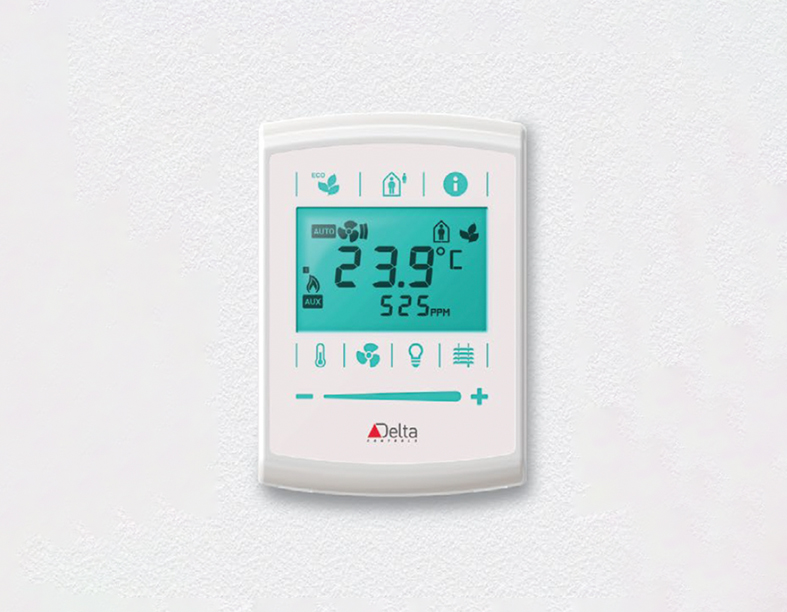
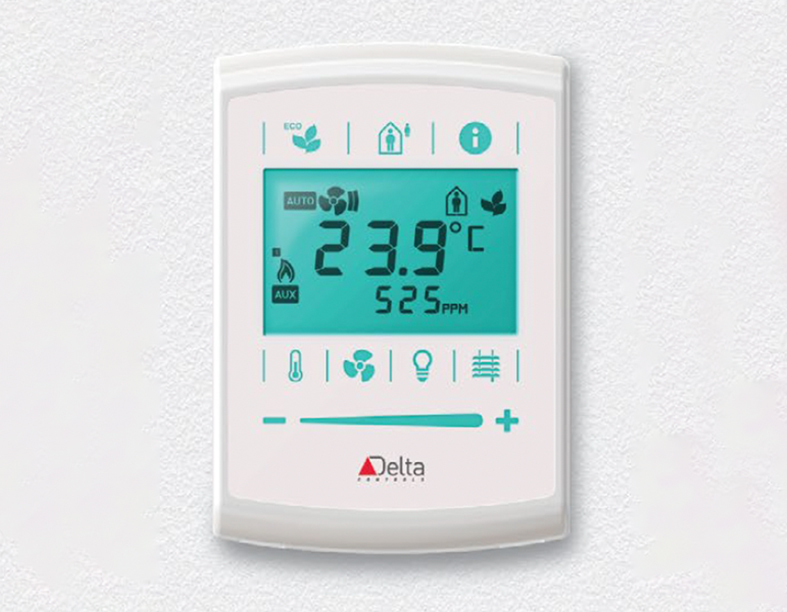
ENTELIZONE NETWORK THERMOSTATS
eZNTW combines the flexibility of Wi-Fi and EnOcean wireless communication with the advanced functionality of a fully programmable thermostat.
A configurable RGB-backlit display provides immediate visual feedback, while wireless connectivity supports fast and efficient communication and a flexible user experience.
Because it reduces dependence on physical cabling, eZNTW is particularly suitable for applications where wiring time and cost are critical factors.
EZNTW
CONFIGURATIONS AND FEATURES
Key features
Wireless connectivity: install the thermostat in a wider range of locations without the time and cost constraints of additional cabling.
Seamless integration: EnOcean wireless connectivity simplifies the integration of a broad range of devices without requiring multiple subnets.
Advanced visual interface: configurable RGB backlighting provides immediate status feedback.
DOWNLOADS
Contact us for more information
FAQ
When should eZNTW be chosen instead of a wired model?
eZNTW is suitable when installing or upgrading a zone thermostat without invasive cabling work. It is particularly useful for retrofit and refurbishment projects, existing buildings or environments where running new cables would be complex, costly or inflexible, and where the main requirement is to upgrade zone temperature control while reducing building work and site downtime.
Thanks to EnOcean wireless connectivity and the Wi-Fi option, eZNTW provides greater flexibility in positioning the thermostat and compatible EnOcean wireless devices, subject to coverage and installation requirements. The product is specifically designed for new installations or retrofit projects where cabling is difficult or expensive.
What checks should be carried out for EnOcean wireless communication?
Before installation, it is important to check radio coverage in the environment, the correct EnOcean frequency for the target market and the presence of physical obstacles or interference that could reduce signal quality.
It is also useful to assess the distance between the thermostat, sensors and wireless actuators; the position of doors, walls, metal elements and electrical panels; and the compatibility of the EnOcean devices to be integrated. eZNTW supports EnOcean for zone control, including sensors and outputs, and can communicate with devices such as door/window contacts, motion sensors, lighting controls, relays and modules for blinds or electrical loads.
How does eZNTW’s configurable RGB display improve the user experience?
The RGB-backlit LCD makes interaction more immediate and intuitive by allowing different colours to be associated with operating conditions, alarms, night modes or room states. Its main advantage is the ability to communicate room status instantly, translating complex technical data into colour changes that can be understood at a glance.
Configurable backlighting and interface-customisation options allow the thermostat to be adapted to the type of building, the brand or the specific needs of occupants.
Does eZNTW support advanced energy-saving strategies?
Yes, natively and comprehensively. DAC PoE is a native BACnet controller supporting BACnet/IP and BACnet over Ethernet communications on the main network. Through the RS-485 subLAN, it can also support network sensors (such as eZNT), I/O expansion modules and, through an optional gateway, Modbus devices. This makes it suitable for environments where different components and subsystems need to be integrated within an interoperable BMS architecture.
How does PoE simplify long-term maintenance?
Yes. eZNTW is a fully programmable BACnet thermostat and can support advanced zone-management logic, especially when integrated with temperature, humidity, CO₂ and occupancy sensors.
GCL+ programming makes it possible to configure customised sequences for HVAC and peripheral devices such as door/window contacts, motion sensors, lighting and shading. This allows system operation to be optimised according to actual space occupancy, parameters measured by the available sensors — including CO₂ where provided — and operating conditions.