
DATA CONTROLS APPLICATION CONTROLLER
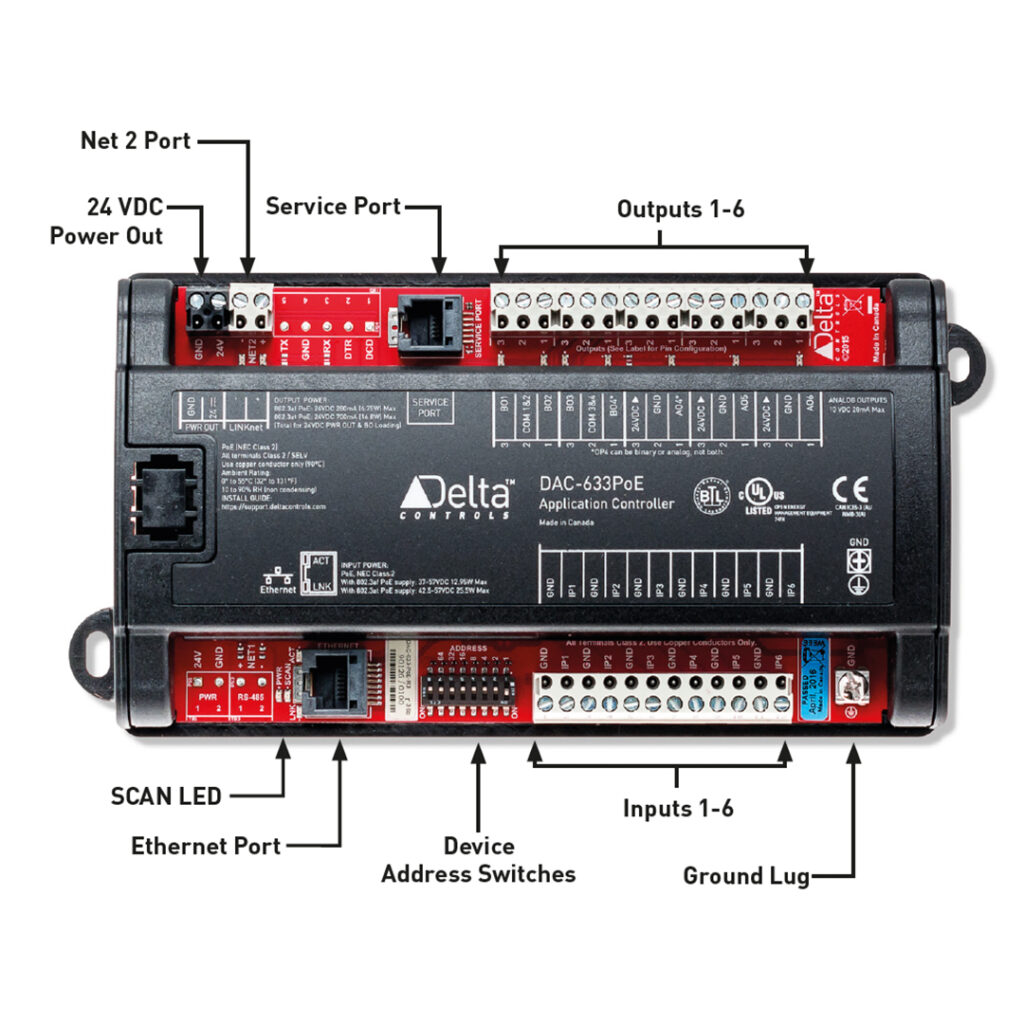
This BACnet controller uses Power over Ethernet (PoE), allowing high-speed communication and power to be delivered through a single Ethernet cable.
This removes the need for additional power cabling and reduces overall system complexity.
By leveraging existing IT infrastructure, the technology can reduce operating costs and improve network efficiency.
DAC POE
CONFIGURATIONS AND FEATURES
Key features
Simplified cabling: reduces cost and complexity by removing the need for additional wiring and making installation and maintenance easier.
Flexibility: new systems and devices can be added quickly, supporting scalable network expansion.
Optimised efficiency: PoE combines power and communication in a single cable, eliminating the need for local control transformers and simplifying overall system management.
DOWNLOADS
Contact us for more information
FAQ
When is it worth choosing a PoE controller?
A PoE controller is the ideal choice when the aim is to simplify installation by reducing the number of cables required for power and communication. DAC PoE uses a single Ethernet cable to carry both electrical power and high-speed data traffic, removing the need for a dedicated local transformer for the controller. It is particularly useful in buildings with reliable existing IT infrastructure or where installation time, cost and wiring complexity need to be reduced.
What network checks should be carried out before installation?
Before installation, it is important to verify that the Ethernet infrastructure is suitable for the project and that the switches support the required PoE standard. The available power budget should also be checked — the total power the switch can supply to connected devices — especially if the controller also needs to power field devices via 24 VDC outputs. Addressing, network segmentation, BACnet/IP compatibility and the building’s IT security requirements should also be verified.
What types of systems can be managed with the DAC PoE controller?
DAC PoE is suitable for applications with limited I/O requirements, such as fan coils, terminal units, unit ventilators and other local HVAC systems.
DAC PoE is suitable for local HVAC applications with limited I/O requirements, particularly fan coils and unit ventilators. Other applications, such as VAV systems or chilled beams, should be assessed case by case according to the required I/O, the actuators to be controlled and the intended control logic.
Thanks to its universal inputs, analogue outputs, binary outputs and full programmability, it can be configured to suit the specific requirements of the application. The technical datasheet identifies it in particular for equipment that does not have a local transformer to power the controller.
Does DAC PoE support interoperability with devices from other manufacturers?
Yes, natively and comprehensively. DAC PoE is a native BACnet controller supporting BACnet/IP and BACnet over Ethernet communications on the main network. Through the RS-485 subLAN, it can also support network sensors (such as eZNT), I/O expansion modules and, through an optional gateway, Modbus devices. This makes it suitable for environments where different components and subsystems need to be integrated within an interoperable BMS architecture.
How does PoE simplify long-term maintenance?
PoE simplifies maintenance by centralising power and communication on a single network infrastructure. This reduces the number of components to check in the field, makes expansion easier and simplifies the addition of new devices. DAC PoE also supports firmware updates and database upload or backup over the network, reducing the need for local intervention and improving long-term management efficiency.