
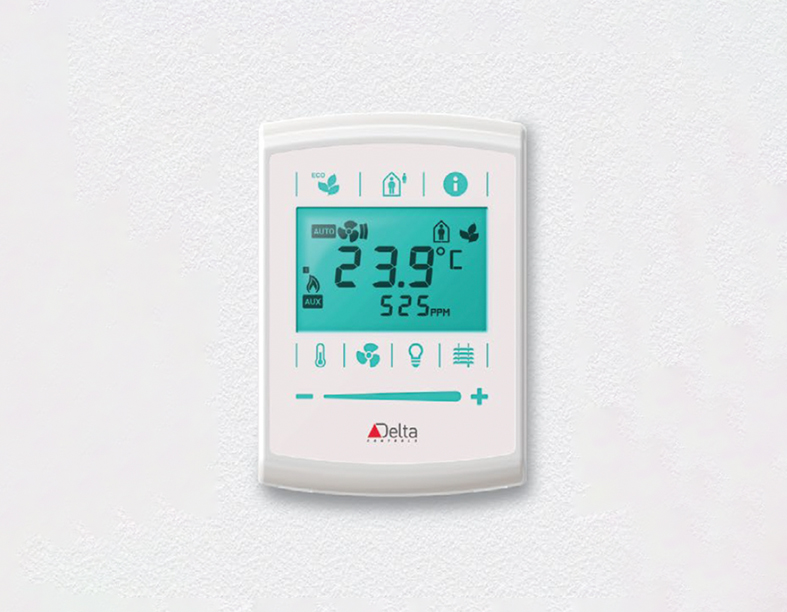
THE THERMOSTAT DESIGNED TO REDUCE COSTS
eZNT goes beyond the capabilities of a standard network thermostat by combining reliable control with strong cost efficiency.
The device is designed for precise, adaptable control. It is fully programmable and includes customisable buttons, RGB backlighting and NFC configuration.
Flexible analogue-output or FET-relay options make it suitable for efficient and versatile energy-management applications.
EZNT
CONFIGURATIONS AND FEATURES
Key features
- Fully programmable: create custom control sequences using GCL+ programming.
- Flexibility: onboard I/O supports a wide range of unitary applications.
- Local trends and alarms: simple configuration supports equipment monitoring and troubleshooting.
DOWNLOADS
Contact us for more information
FAQ
How should the most suitable eZNT model be selected?
For simpler applications, a model used mainly as a network sensor may be sufficient, while local control of HVAC equipment may require versions with more onboard analogue or digital inputs and outputs. The choice should therefore take into account existing wiring, the devices to be controlled, required sensors such as temperature, humidity, CO₂ and occupancy, and any need for custom logic through GCL+ programming.
When are NFC and RGB backlighting useful?
These two technologies address two different building-lifecycle requirements: efficiency during installation and the end-user experience.
- NFC (Near Field Communication) technology: a valuable tool for optimising commissioning, including installation, configuration and start-up. NFC allows System Integrators and technicians to configure the thermostat using compatible mobile devices, even when the product is already wall-mounted or still in its packaging. This simplifies commissioning, reduces time on site and speeds up the configuration of multiple devices.
- RGB backlighting and customisable overlays: this combines functional design with visual comfort. RGB backlighting improves both the user experience and visibility of system status. It can highlight operating conditions, night mode, alarms or specific room states, making the thermostat more intuitive even for non-technical users. Together with customisable overlays, it also allows the interface to be adapted to the architectural context, interior décor or client branding.
What is meant by the eZNT thermostat’s "onboard I/O flexibility"?
Onboard I/O flexibility means that inputs and outputs are built directly into the thermostat and can be used to connect sensors, contacts or controlled devices without necessarily requiring external modules. Depending on the model, eZNT can include configurable universal inputs and analogue or digital outputs suitable for different HVAC and room-control applications.
In practical terms, this allows the thermostat to adapt to different systems, for example modulating valves, fan coils, dampers, window contacts, occupancy sensors, ventilation controls or other auxiliary functions compatible with the I/O configuration and implemented control logic. I/O flexibility makes eZNT more versatile than a traditional thermostat because it supports local, customised control logic based on the building’s requirements.
Can the eZNT thermostat manage automatic energy-saving logic?
Yes. eZNT is a programmable thermostat and can support control logic designed to improve energy efficiency without compromising occupant comfort. GCL+ programming, optional sensors and local scheduling, trend and alarm functions make it possible to configure automatic strategies based on time schedules, environmental conditions, occupancy or air quality.
For example, motion, humidity or CO₂ sensors can support strategies such as demand-controlled ventilation, occupancy-based control or setpoint optimisation during unoccupied periods. This allows the system to reduce unnecessary consumption while maintaining suitable environmental conditions only where and when they are actually required.